- Hinjewadi Society Shows a Simple Way to Live Peacefully With Community Dogs
- Daily Life Inside a Typical Hinjewadi Housing Society
- Understanding the Real Problem Faced by Residents
- Discussions That Lasted for Months
- A Dedicated Dog Feeding Area Takes Shape in Hinjewadi
- How Structure Reduced Fear Among Residents
- Relief for Animal Lovers and Feeders
- Better Hygiene and Easier Maintenance
- Positive Changes in Dog Behaviour
- Why This Matters for Hinjewadi and Other Cities
- A Model Other Hinjewadi Societies Can Follow
- Why Removing Dogs Is Not a Solution
- What This Says About Community Living in Hinjewadi
- FAQs About Community Dog Feeding in Hinjewadi
- A Small Step With a Big Impact
- Related Posts
Hinjewadi Society Shows a Simple Way to Live Peacefully With Community Dogs
Hinjewadi is known as Pune’s biggest IT hub, but it is also home to thousands of families living in large housing societies. Like many fast-growing areas in India, Hinjewadi faces daily urban issues that are not always about roads or traffic. Some problems are smaller but deeply emotional. One such issue is how people and community dogs share the same living space.
In many housing societies across Hinjewadi, dog feeding often turns into a reason for arguments. Residents worry about safety, hygiene, and noise. Animal lovers worry about hunger, cruelty, and neglect. These two sides usually clash, and most societies struggle to find a middle ground.
But one society in Hinjewadi has shown that the problem is not as complex as it looks. Megapolis Sangria Society has taken a calm, structured, and practical step that has helped both residents and community dogs live peacefully together.
Daily Life Inside a Typical Hinjewadi Housing Society
Life in a Hinjewadi society follows a familiar pattern. Evenings are usually busy. Children play downstairs. Parents walk after dinner. Senior citizens sit and chat about old times. Security guards manage entry points, and delivery bikes come and go.
Megapolis Sangria Society is no different. It is a large residential complex with families from different backgrounds. Like many societies in Hinjewadi, it also has community dogs that have lived there for years. These dogs are familiar faces and are often seen resting near buildings or walking around calmly.
Earlier, feeding these dogs was not organised. Different people fed them at different places and at different times. Food bowls appeared near parking areas, entrances, and walkways. Dogs would gather wherever they expected food. This created fear and confusion among some residents, especially parents and senior citizens.
Understanding the Real Problem Faced by Residents
The managing committee and residents of Megapolis Sangria Society began to notice something important. The dogs were not aggressive by nature. The issue was the lack of structure.
Rushali Gupta, a society member, explained that people felt unsafe mainly because dogs would gather suddenly at random places. This happened because dogs were unsure when and where food would come. That uncertainty caused chaos, not the dogs themselves.
When residents shared their concerns, the society’s planning body listened carefully. Instead of blaming feeders or demanding removal of dogs, they tried to understand why fear existed in the first place.
This approach made a big difference. The focus shifted from “dogs are a problem” to “how can we manage this better.”
Discussions That Lasted for Months
The solution did not happen overnight. For several months, residents of Megapolis Sangria Society in Hinjewadi discussed different ideas. Meetings were held. Suggestions were shared. Some people worried about hygiene. Others worried about children’s safety. Animal lovers worried about harassment and cruelty.
The managing committee played an important role here. They collected ideas, removed emotional reactions, and focused on practical solutions. They looked at examples from other cities and spoke to residents who had experience with animal welfare.
Slowly, a clear idea started to form. The society needed a fixed place and a fixed system for feeding community dogs.
A Dedicated Dog Feeding Area Takes Shape in Hinjewadi
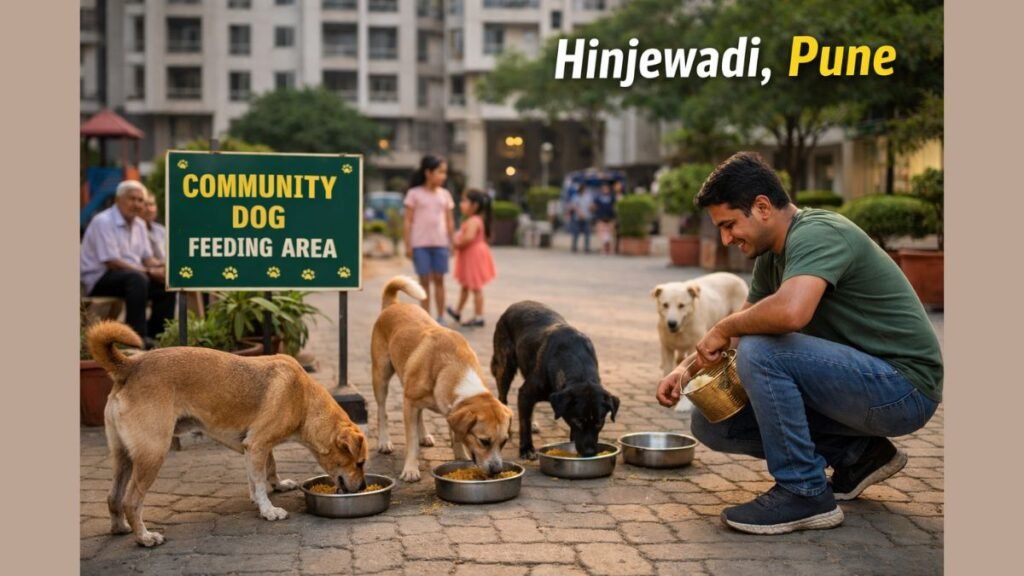
On December 21, Megapolis Sangria Society officially opened a dedicated community dog feeding area. This decision marked an important moment, not just for the society, but for Hinjewadi as a whole.
The feeding area was carefully planned. It was placed away from children’s play zones, building entrances, and parking areas. This ensured that dogs would not crowd spaces where people regularly walk or sit.
Feeding timings were fixed. This helped dogs understand when food would be available. Clean-up after feeding was made compulsory. Volunteers from the society took responsibility for maintaining hygiene and discipline.
Stainless steel bowls were used, and food was served in an organised manner. Dogs now walk calmly to the feeding area instead of roaming around in search of food.
How Structure Reduced Fear Among Residents
Once the feeding area became active, many residents noticed a clear change. Dogs stopped gathering near random spots. They waited near the designated area during feeding time and moved away afterward.
Parents felt more relaxed because their children could play without sudden encounters. Senior citizens felt safer during evening walks. Maintenance staff found it easier to clean common areas since food was no longer scattered across the society.
This simple structure reduced fear without harming the dogs. It showed that planning can solve problems that arguments cannot.
Relief for Animal Lovers and Feeders
Before this system, feeding dogs in Hinjewadi societies often felt stressful. Feeders were questioned, judged, or asked to stop. Many animal lovers felt they had to explain themselves every day.
Mahul, a resident and pet parent, shared that earlier, feeding dogs felt like something you always had to defend. With the new system, feeding became disciplined and accepted. There was clarity, and no one felt cornered.
This change also reduced tension between residents. Clear rules meant fewer misunderstandings. People knew what to expect, and that brought peace.
Better Hygiene and Easier Maintenance
One major concern in Hinjewadi housing societies is cleanliness. Unplanned feeding often leads to leftover food, spilled water, and flies. With a single feeding spot, cleaning became easier.
Maintenance teams could focus on one area instead of chasing multiple locations. Volunteers ensured that bowls were cleaned and stored properly. Waste disposal was handled responsibly.
This helped maintain hygiene and improved the overall environment of the society.
Positive Changes in Dog Behaviour
Another important change was seen in the dogs themselves. Predictable feeding times reduced stress among them. They no longer needed to roam or compete aggressively for food.
Dogs appeared calmer and more relaxed. Their movement became predictable. This reduced barking, chasing, and sudden crowding.
Animal welfare advocates believe that food security plays a big role in animal behaviour. When dogs know they will be fed regularly, they feel safe.
Why This Matters for Hinjewadi and Other Cities
Hinjewadi is growing fast. New buildings come up every year. Shared spaces are shrinking. Conflicts over common areas are becoming more frequent.
In such an environment, small steps like this matter a lot. Megapolis Sangria Society’s approach shows that coexistence is possible without forcing one side to suffer.
Krish Nerurkar, a Pune-based animal rescuer, described this initiative as a true example of coexistence. Instead of removing dogs or banning feeding, the society chose care and structure.
A Model Other Hinjewadi Societies Can Follow
Many housing societies in Hinjewadi face the same issue but do not know where to start. This model offers a clear path.
Key elements that made it work
| Aspect | What the society did |
|---|---|
| Location | Kept feeding area away from busy zones |
| Timing | Fixed feeding hours |
| Hygiene | Mandatory clean-up after feeding |
| Responsibility | Volunteers took charge |
| Communication | Open discussions with residents |
This table shows that the solution is simple and practical. It does not need heavy spending or strict rules.
Why Removing Dogs Is Not a Solution
In many cases, societies try to relocate or remove community dogs. This often creates legal trouble and does not solve the problem. New dogs come in, and the cycle starts again.
Megapolis Sangria Society understood that dogs were already part of the neighbourhood. Managing their presence was better than fighting it.
This approach saved time, reduced conflict, and created a healthier environment.
What This Says About Community Living in Hinjewadi
Community living is about adjustment and understanding. Hinjewadi brings together people from different cities, cultures, and lifestyles. Conflicts are bound to happen.
But this example shows that listening matters. When people stop shouting and start planning, solutions appear.
This is not just about dogs. It is about how cities like Hinjewadi can grow without losing empathy.
FAQs About Community Dog Feeding in Hinjewadi
Is feeding community dogs legal in Hinjewadi societies?
Yes. Feeding community dogs is allowed as long as it does not cause hygiene or safety issues. Structured feeding helps avoid problems.
Does a feeding area increase dog population?
No. Feeding does not increase population. Sterilisation and vaccination programs control numbers, not hunger.
Can other Hinjewadi societies adopt this model?
Yes. Any society can do this with basic planning, resident discussions, and volunteer support.
Does this system reduce dog-related complaints?
Yes. Predictable feeding reduces roaming, noise, and fear among residents.
A Small Step With a Big Impact
What Megapolis Sangria Society did may look simple, but its impact is deep. It reduced fear, improved hygiene, and brought peace among residents.
In a busy area like Hinjewadi, where stress levels are already high, such solutions matter. They remind people that coexistence is not about choosing sides. It is about finding balance.
This initiative proves that when structure replaces confusion, everyone benefits. Humans feel safer. Dogs feel calmer. And the society feels more like a community.
Hinjewadi needs more such stories. Not loud debates. Just simple, thoughtful actions that work.
To check more about Hinjewadi, Click Here.

I’m Priya Agarwal, and I write about everything related to Hinjewadi! From the latest news and events to hidden spots and local businesses, my articles are all about helping you explore and enjoy this vibrant area. Whether you live here or are just visiting, I aim to bring you useful, interesting, and up-to-date information about Hinjewadi. Stay tuned for more!